- From the section US & Canada
- 20 May 2015
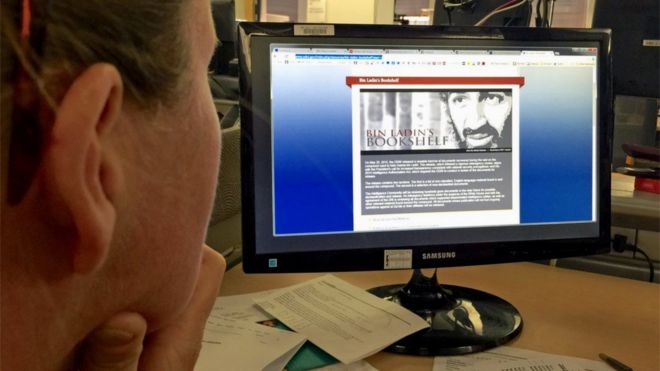
The documents are now available on a
US government website
In his final years, Osama Bin Laden
urged his followers to remain focused on attacking the US, newly released
documents show.
US officials have published a trove of files found at his
Pakistan hideout the night the al-Qaeda chief was killed.
They include Arabic correspondence
with his lieutenants, a love letter to one of his wives and an application form to join the terror group.
He also had English language books
on economic and military theory.
In one of the letters, Bin Laden
instructs one of his deputies to tell "our brothers" that they must
remained focused on fighting Americans.
Their "job is to uproot the
obnoxious tree by concentrating on its American trunk, and to avoid being
occupied with the local security forces," he writes.
The Office of the Director of
National Intelligence (ODNI) said a "rigorous" review had taken place
before the spy agency ordered the release of the documents.
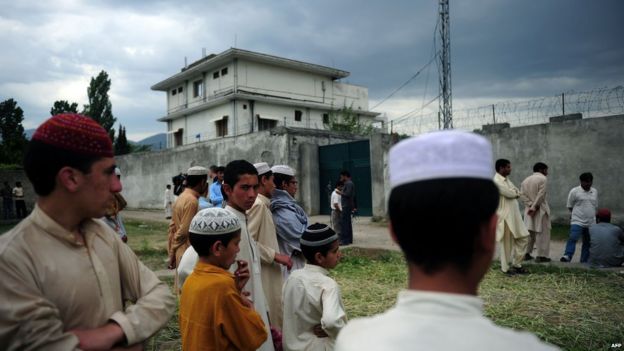
The documents were recovered at this
house in Abbottabad, Pakistan
There are 103 papers and videos in
all, including a number of translated letters, notes, and other materials
detailing al-Qaeda operations. Many of the documents also have a version
available in Arabic.
One letter mocks President George W
Bush's War on Terror, with Bin Laden writing that it had not created stability
in Iraq or Afghanistan.
There is also section entitled
Materials Regarding France, which includes a number of academic reports and
articles about France's military, politics and economy.
Also listed is a document described
as a "suicide prevention guide", several English language books
including Bob Woodward's Obama's Wars, several maps, and a few video game
guides.
He made a video letter to one of his
wives, in which he says: "Know that you do fill my heart with love,
beautiful memories, and your long-suffering of tense situations in order to
appease me and be kind to me".
Analysis
- Gordon Corera, BBC security correspondent
They say you can tell a lot about a
person from their bookshelf. But what can we tell about the leader of al-Qaeda
from his? Firstly, he wanted to know his enemy - he seems to have read plenty
on America including bestsellers like Obama's Wars by Bob Woodward.
Unsurprisingly, he also seemed to
favour books which were critical of American power such as by Noam Chomsky or
Confessions of an Economic Hit Man by John Perkins which recounted the author's
claims of American companies exploiting the developing world.
There's also an element of trying to
learn his opponents' weaknesses and vulnerabilities - retired British colonel
John Hughes-Wilson's book on military intelligence blunders makes an appearance
as do books on guerrilla warfare.
There also some books which perhaps
suggest a bit of wish fulfilment - The Rise and Fall of the Great Powers by
Paul Kennedy for instance.
Also on the list is Imperial Hubris
by Michael Scheuer - the CIA analyst who first ran the unit dedicated to
tracking Osama Bin Laden back in the middle 1990s and also, rather oddly, a
book entitled A Brief Guide to Understanding Islam.
Also on the list was Checking Iran's
Nuclear Ambitions by Patrick Clawson. When asked by the BBC about his feelings
when he heard, Mr Clawson replied sarcastically: "Wonderful, I am glad it
is read in such high circles."
Among the documents appears to be an
application to join the ranks of al-Qaeda, including questions about hobbies
and a willingness to be a martyr.
The documents are being released in
the wake of President Obama's calls for greater transparency, said Jeffrey
Anchukaitis, a spokesman for the ODNI.
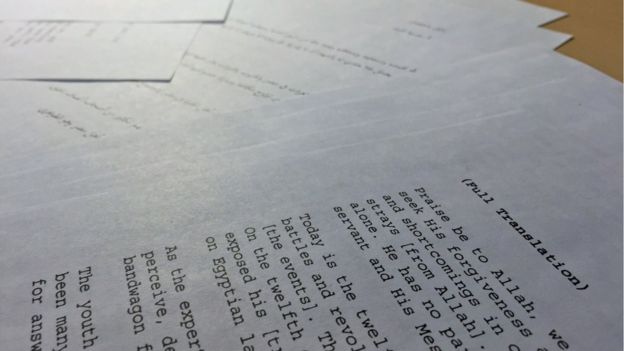
Many of the documents on the US
government website were in the form of English language translations, as seen
in these printouts
"The intelligence community
will be reviewing hundreds more documents in the near future for possible
declassification and release," he said.
Some of the material that has been
included in the trove was previously declassified for use in federal prosecutions.
Bin Laden was killed in a raid by US
special forces on his compound in Abbottabad, Pakistan, in May 2011.
In 2012, some documents found in the
operation were released by the West Point US military
academy.

