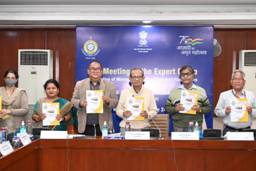
Expert Group unveils report on base revision of Wage Rate Index (WRI) to 2016=100 from base 1963-65=100.
Prof.
S.P.Mukherjee, Chairman of Expert Group on Minimum Wages & National
Floor Wages, Dr G.C.Manna, Chairman of Technical Advisory Committee of
Wage Rate Index, Shri DPS Negi, Principal Advisor, Ministry of Labour
& Employment, Ms. Sibani Swain, Additional Secretary, Ministry of
Labour & Employment, Ms. Vibha Bhalla, Joint Secretary, Ministry of
Labour & Employment and Shri I.S. Negi, DGLB & other members of
Expert Group released the new series of Wage Rate Index (WRI)
with base year 2016=100, being compiled and maintained by Labour
Bureau, an attached office of Ministry of Labour & Employment. The new series of WRI with base 2016=100 will replace the old series with base 1963-65=100.
Shri DPS Negi, Principal Advisor, Ministry of Labour & Employment lauded the efforts of Labour
Bureau for their steadfastness and exemplary role which have finally
culminated in the release of updated series of WRI. While admiring the
efforts, he also stressed upon the need for data on all aspects of
labour as it will be crucial to serve as inputs in policy making and
this justifies the existence of an organization like Labour Bureau. With
the ever increasing importance of data in the times to come coupled
with the fact that India is a labour abundant nation, a dedicated
organization for labour and price statistics like the Labour Bureau
merits strengthening.
The
Report on “New Series of Wage Rate Index (Base 2016=100)” is an
important publication meant to give insights into the concepts,
definitions and methodology related to the new series of WRI with 2016
as base year. This will serve as a useful reference book for
researchers, academicians, scholars and all other stakeholders of WRI.

The
Government of India periodically revises the base year for major
economic indicators to reflect the changes in the economy and to capture
the wage pattern of workers.
Thus,
as per the recommendations of International Labour Organization (ILO),
National Statistical Commission (NSC) etc. the base year of Wage Rate
Index numbers has been revised from 1963-65=100 to 2016=100 by the
Labour Bureau, Ministry of Labour & Employment to enhance the
coverage and to make index more representative.
The
new series of Wage Rate Index i.e. 2016=100 replaces the old series
(1963-65=100) which is almost six decades old, has increased the scope
and coverage in terms of number of industries, sample size, occupations
under selected industries, weightage of industries etc. Technical
Advisory Committee (TAC) on WRI constituted by MoL&E under the
chairmanship of Dr. G.C. Manna, former DG, CSO, provided all technical
inputs for construction of New WRI Series.
Prof.
S.P.Mukherjee and other Members of the Expert Group on Minimum Wages
& National Floor Wages were of the opinion that this base revision
of the Wage Rate Index 2016=100 will play a very critical role in coming
out with the Minimum Wages & National Floor Wages along with other
parameters which will be decided in due course of time by the Expert
Group.
Key Highlights
The New WRI Series with base 2016=100 would be compiled twice a year on point-to-point half yearly basis, as on 1st January and 1st
July of every year. Some of the major improvements made under the new
series of WRI (2016=100) vis-à-vis old series (1963-65=100) are as
under:
- The weighting diagram in the new WRI series has been prepared from the results of the Occupational Wage Survey (Seventh) round.
- A total of 37 industries have been covered in the new WRI basket (2016=100) as against 21 industries in the 1963-65=100 series.
- The
selected 37 industries in the new series are categorized as 30
industries from Manufacturing sector, 4 industries from Mining Sector
and 3 industries from Plantation Sector as compared to 14 industries
from Manufacturing sector, 4 industries from Mining Sector and 3
industries from Plantation Sector in the old series.
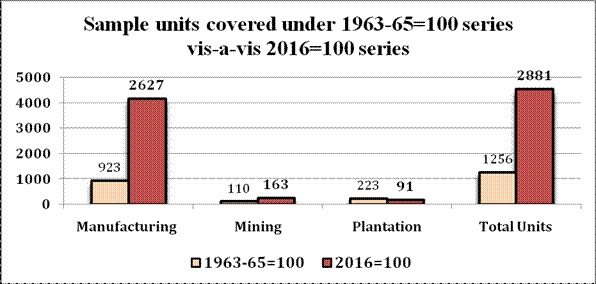
- In
the new WRI basket, the current wage data has been collected from 2881
units under 37 selected industries as against to 1256 units under 21
industries in the old series of WRI.
- About 700 occupations have been covered under 37 selected industries in new series of WRI (2016=100).
Weighting Pattern
- The
weights used in WRI Series with base 1963-65=100 were the base year
estimated employment figures in respective occupations in each selected
industry.
- The
weights adopted for the construction of WRI numbers under New WRI
Series (Base: 2016=100) are the base year estimated employment figures
in the respective occupations in each selected industry. The weighted
average of the occupation level indices in an industry, weights being
the base year estimated total employment bill in each occupation, gives
WRI at the industry level. Similarly, the weighted average of the
industry/Sector level indices, weights being the base year estimated
total employment bill in each industry/sector, gives Sectoral/All-India
Index.
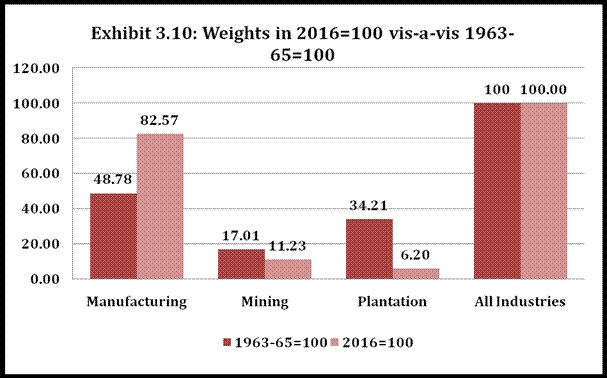
- Sector wise major changes in weights, number of industries and sample units between 1963-65=100 series and 2016=100 series are as under:
|
Sector
|
No. of Industries
|
Weights
|
Sample Units
|
|
1963-65
|
2016
|
1963-65
|
2016
|
1963-65
|
2016
|
|
Manufacturing
|
14
|
30
|
48.78
|
82.57
|
923
|
2627
|
|
Mining
|
4
|
4
|
17.01
|
11.23
|
110
|
163
|
|
Plantation
|
3
|
3
|
34.21
|
6.20
|
223
|
91
|
|
All
|
21
|
37
|
100.0
|
100.0
|
1256
|
2881
|
The
sector level weights under new series has changed in comparison to old
series (1963-65=100). The weight of Manufacturing sector has increased
substantially over time whereas the weight of Plantation sector and
Mining sector has declined under 2016=100 series vis-à-vis 1963-65=100
series.
Manufacturing Sector
- Sixteen
new Manufacturing Industries have been added in the new series of WRI
basket, viz. Synthetic Textiles, Textile Garments, Printing and
Publishing, Footwear, Petroleum, Chemical & Gases, fertilizers,
Drugs & Medicines, Iron & Steel, Electrical Apparatus, Motor
Vehicles, Motor Cycles, Tea Processing, Tyres & Tubes, Milk Products
and Plastic Articles.
Mining Sector
- In
the new series, Oil Mining Industry has been newly introduced in the
basket in place of Mica Mines Industry, to make mining sector more
representative of the three different kinds of Mining viz. Coal, Metal
and Oil.
Plantation Sector
- Three plantation industries namely Tea, Coffee and Rubber have been retained in the new WRI basket with enhanced coverage.
WRI Index
- The All India Wage Rate Index Number for all the 37 industries stood at 119.7 in 2020 (half yearly 2) which shows an increment of 1.6 per cent over the index in 2020 (half yearly 1).
- At
sector level, the highest Wage Rate Index in 2020 (half yearly 2) was
reported in Plantation Sector (126.5) followed by Manufacturing Sector
(119.6) and Mining Sector (116.7).
- Among
37 Industries covered, the highest Wage Rate Index was recorded in
Drugs & Medicines (131.4), followed by Sugar (129.8), Motor Cycles
(128.1), Jute Textiles (127.9) and Tea Plantation (127.7). On the other
hand, the lowest Wage Rate Index was recorded in Rubber Plantation
(106.7), followed by Paper (110.7), Castings & Forgings (111.3),
Woollen Textiles (111.9) and Synthetic Textiles (112.0).
Intra-Sector Variations
- Among
Thirty Manufacturing Industries, the highest Wage Rate Index during
2020 (half yearly 2) was recorded in Drugs & Medicines (131.4),
followed by Sugar (129.8), Motor Cycles (128.1), Jute Textiles (127.9)
and Tea Processing (127.6). On the contrary, the lowest Index in
Manufacturing Sector was recorded in Paper (110.7), followed by Castings
& Forgings (111.3), Woollen Textiles (111.9), Synthetic Textiles
(112.0) and Textile Garments (112.4).
- Among
Four Mining Industries, the maximum Wage Rate Index was recorded in
Iron Ore Mines (122.9), followed by Oil Mining (117.4) and Coal Mines
(116.3). The minimum Wage Rate Index in this sector was recorded in
Manganese Mines (114.5).
- In
Plantation Sector, the maximum Wage Rate Index was reported in Tea
Plantation (127.7), whereas the minimum Index was recorded in Rubber
Plantation (106.7).
- Out
of total thirty seven industries covered for compilation of indices,
the Wage Rate Index of twelve Manufacturing industries, two industries
in Mining industries and one Plantation industry had lower Wage Rate
Index than all industries combined Wage Rate Index of 119.7.
Average Daily Absolute Wage Rates
- The
All India Average Daily Absolute Wage Rate stood at Rs. 588.5 in 2020
(half yearly 2) as compared to Rs. 576.1 in 2020(half yearly 1),
registering a growth rate of 1.6 per cent.
- Among
three sectors covered during 2020 (half yearly 2), the highest Average
Daily Absolute Wage Rate was recorded in Mining Sector (Rs. 1604.3),
followed by Manufacturing Sector (Rs. 475.0) and lowest (Rs. 212.3) in
Plantation Sector.
- Among
Manufacturing industries, the highest Average Daily Absolute Wage Rate
was recorded in Tyres & Tubes (Rs. 731.7), followed by Petroleum
(Rs. 705.3), Jute Textiles (Rs. 698.5), Sugar (Rs. 694.9) and Milk
Products (Rs. 634.6). The lowest Average Daily Absolute Wage Rate in the
sector was reported at Rs. 196.2 in Match industry.
- Among
Mining industries, the highest and lowest Average Daily Absolute Wage
Rate was reported in Coal Mines (Rs. 1730.4) and Iron Ore Mines (Rs.
679.4), respectively.
- In
Plantation Sector, the highest and lowest Average Daily Absolute Wage
Rate varied between Rs. 425.2 in Rubber Plantation and Rs. 193.7 in Tea
Plantation.
Average Daily Real Wage Rates at 2001 Prices
- The
All India Real Wages at 2001 prices stood at Rs. 174.3 in 2020(half
yearly 2) as compared to Rs. 174.6 in 2020 (half yearly 1).
- Among
three sectors covered, the highest Average Daily Real Wage Rate at 2001
prices was reported in Mining sector (Rs. 477.5) followed by
Manufacturing sector (Rs. 141.4) and in Plantation Sector, the Average
Daily Real Wages was reported as low as Rs. 63.2.
The Technical Advisory Committee on WRI has approved the new series of Wage Rate Index with base 2016=100.
The same will also be available on the official website at https://labour.gov.in & www.labourbureaunew.gov.in.
*****
VRRK/AK


No comments:
Post a Comment